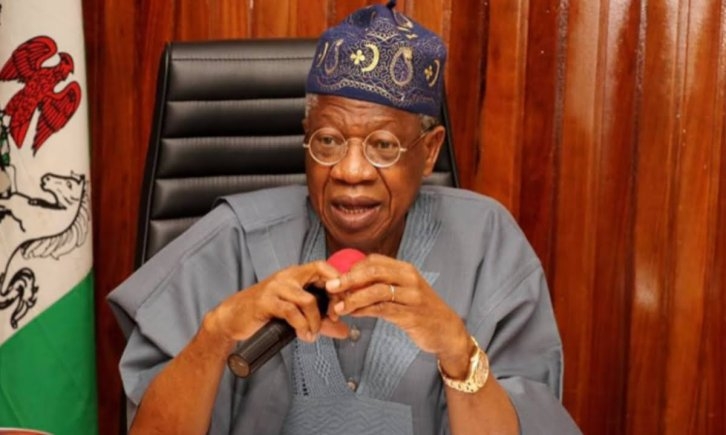
Nigeria’s former Minister of Information and Culture, Alhaji Lai Mohammed, has delivered a compelling account of how strategic communication played a pivotal role in uniting a fragmented opposition and ultimately toppling the ruling party in the 2015 general elections. Speaking at Abbey College in Cambridge, UK, on Wednesday, Mohammed traced the journey from political defeat in 2003 to national victory in 2015, emphasizing the power of disciplined messaging and public engagement. He described the 2003 elections as a “political tsunami” that devastated the opposition, particularly his former party, the Alliance for Democracy (AD), which lost five of its six states to the ruling Peoples Democratic Party (PDP). The PDP’s victory expanded its control to 28 states, while the AD was reduced to just Lagos.
When Nigeria returned to democracy in 1999, the political landscape was more balanced. The PDP held 21 states, the All Peoples Party (APP) had nine, and the AD secured six. But by 2003, the opposition was in disarray. The APP, later rebranded as the All Nigeria Peoples Party (ANPP), lost two states and remained with seven, while the AD was virtually erased from the political map. This collapse forced the AD to seek new alliances, eventually leading to the formation of the Action Congress of Democrats (ACD), which evolved into the Action Congress (AC) and later the Action Congress of Nigeria (ACN).
Despite controlling only one state, the ACN leveraged communication as its primary weapon. Mohammed stressed that every message had to cut through the noise to remain relevant. “In those times, communication served as our most powerful tool. Each word held significance. Every message needed to penetrate the noise, for if it failed to do so, we simply did not exist in the public’s awareness,” he said. Through consistent outreach, clear messaging, and sustained advocacy, the ACN gradually rebuilt its influence. It expanded from one state to six, laying the foundation for broader coalitions.
This momentum culminated in the creation of the All Progressives Congress (APC) in 2013, which quickly emerged as the dominant opposition force. The APC’s victory in the 2015 elections marked a historic shift — the first time a ruling party was defeated nationally in Nigeria’s democratic era. Mohammed reflected on this experience, stating that communication is not just about speaking, but about persistence, clarity, and strategic positioning. His time in opposition shaped his approach when he became Minister of Information and Culture in 2015. “It solidified my conviction that communication is not an accessory to politics or governance,” he said. “It is an essential tool for both.” His insights underscore the enduring importance of strategic communication in shaping Nigeria’s political future.




Leave a Comment