ADC Petitions NJC, Demands Probe into Justices Tsoho and Lifu Over Nafiu Gombe Case

ADC Petitions NJC, Demands Probe into Justices Tsoho and Lifu Over Nafiu Gombe Case

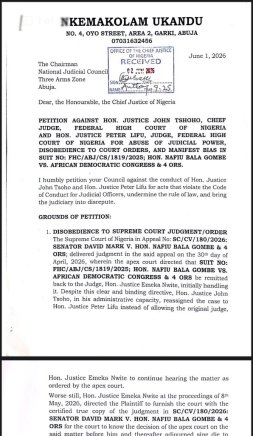
The African Democratic Congress (ADC) has formally petitioned the National Judicial Council (NJC) to investigate the conduct of Justice John Tsoho, Chief Judge of the Federal High Court, and Justice Peter Lifu, over alleged misconduct in the handling of a legal suit involving the party and its former National Chairman, Nafiu Bala Gombe. The petition, dated June 1, 2026, and addressed to the Chief Justice of Nigeria, was filed by Nkemakolam Ukandu, who represents the ADC in the matter. Ukandu alleges abuse of judicial power, disobedience to court orders, and manifest bias in Suit No. FHC/ABJ/CS/1819/2025.

The core of the petition centers on the Supreme Court’s judgment in Appeal No. SC/CV/180/2026, which involved Senator David Mark and Nafiu Bala Gombe. The apex court ruled that the case be remitted to Justice Emeka Nwite, who had originally presided over it. Despite this binding order, Justice Tsoho reassigned the matter to Justice Peter Lifu, a move Ukandu argues violates the Supreme Court’s directive and undermines judicial authority. According to Section 287(1) of the 1999 Constitution, decisions of the Supreme Court are binding on all lower courts, making the reassignment a serious breach of constitutional principle.

Ukandu further claims that Justice Nwite, during proceedings on May 8, 2026, directed the plaintiff to submit a Certified True Copy of the Supreme Court judgment and adjourned the case indefinitely until compliance. He argues that the subsequent scheduling of the matter before Justice Lifu on June 3 disregards both the Supreme Court’s remittance order and Justice Nwite’s earlier directive. This, he says, constitutes a clear disregard for judicial process and undermines public confidence in the judiciary.

The petition also accuses Justice Tsoho of misusing his administrative powers by transferring the case without legal justification. Ukandu asserts that the reassignment creates an appearance of bias and may encourage forum shopping, where parties seek favorable courts or judges. He notes that concerns about the transfer were previously raised in court by his counsel, who objected to the case being moved to either Justice Lifu or Justice Joyce Abdulmalik.

In addition to the procedural violations, the petition alleges that both judges may have breached the judicial oath and the Code of Conduct for Judicial Officers. Ukandu urges the NJC to conduct a thorough investigation into the actions of Justices Tsoho and Lifu, determine if they abused their powers or disobeyed court orders, and impose appropriate disciplinary measures if warranted. He also calls for immediate compliance with the Supreme Court’s remittance order and Justice Nwite’s directive.

This development highlights growing concerns about judicial independence and accountability in Nigeria’s legal system. As the NJC considers the petition, the case may set a precedent for how courts handle appeals and remittances, especially when constitutional mandates are at stake. The outcome could have far-reaching implications for judicial integrity and public trust in Nigeria’s judiciary.