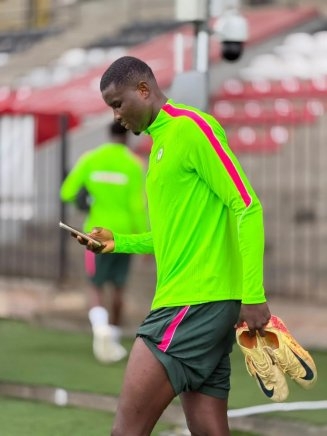
Turkey’s disappointing 2-0 loss to Australia in their opening World Cup match has sparked renewed discussion about the national team’s long-standing need for a reliable centre forward, with Trabzonspor’s Nigerian striker Paul Onuachu emerging as the ideal solution many believe has been missing. The Turkish side relied heavily on crosses from the flanks during the game, but their attacking strategy failed to break down Australia’s physically dominant backline. Analysts and fans alike have pointed to the absence of a traditional target man as a key reason for the team’s struggles in front of goal.
The lack of a clear number nine became a major talking point as Turkey’s aerial deliveries repeatedly failed to find a decisive finisher. Despite efforts from players like Kerem Aktürkoğlu, who fought hard at the front, the team lacked the physical presence needed to challenge Australia’s tall defenders. Trabzonspor reporter Birol Sancak highlighted this issue in his column for Taka Gazete, noting that the team’s approach exposed a fundamental gap in their attacking setup.
Sancak wrote, “It was even more striking that these crosses were made to Kerem Aktürkoğlu, who was fighting hard at the forefront and proving ineffective.” He emphasized that Turkey has been grappling with the absence of a true number nine for years and that a striker in the mould of Paul Onuachu would have made a significant difference against Australia’s compact defence. Onuachu, known for his strength, aerial ability, and penalty-box prowess, has established himself as a dominant force in Turkish football.
His ability to hold up the ball, win duels, and convert crosses into goals makes him a perfect fit for a team that often relies on wide play and set pieces. In a match where Turkey’s crosses were routinely cleared or misdirected, Onuachu’s presence could have provided a focal point and created more scoring opportunities. His physicality and experience in high-pressure situations would have added a new dimension to Turkey’s attack.
While Onuachu currently plays for Trabzonspor and represents Nigeria internationally, his profile and playing style have drawn admiration from Turkish football circles. The debate over his potential role in the national team reflects a broader conversation about tactical flexibility and the need for diverse attacking options. As Turkey prepares for their next World Cup fixture, the question of whether they can adapt their strategy to include a more traditional striker remains a critical issue.
The performance against Australia has underscored the importance of having a reliable target man in modern football, especially in high-stakes tournaments. Moving forward, Turkey’s coaching staff may need to reconsider their attacking approach to ensure they are better equipped to face physically strong defences in future matches.



Leave a Comment