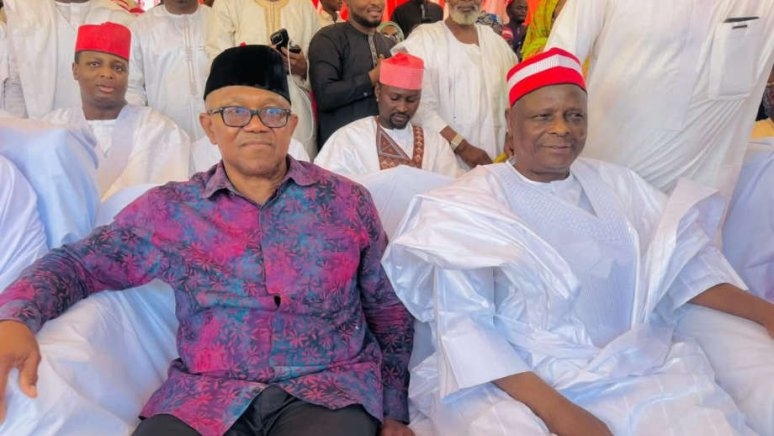
Former presidential aide Bashir Ahmad has warned that Peter Obi, flag bearer of the Nigeria Democratic Congress (NDC), and his running mate Rabi’u Kwankwaso may abandon the party if their political ambitions are not met, particularly ahead of the 2027 elections. Ahmad made the statement in a post on his verified X account, highlighting a potential rift between the party’s leadership and its presidential aspirants. He emphasized that Obi and Kwankwaso view the NDC primarily as a vehicle for the 2027 general elections, not as a long-term political home.
Ahmad pointed out that the differing political timelines and objectives between the party’s national leader, Seriake Dickson, and Obi-Kwankwaso’s team could create lasting tensions. According to him, Dickson is focused on building a strong, sustainable political platform with an eye on the 2031 presidential race, rather than just winning the upcoming election. This long-term vision, Ahmad argued, may not align with Obi and Kwankwaso’s immediate electoral goals.
He further stated that if their expectations within the NDC are not fulfilled, the duo will likely seek another political platform before 2031. “If Obi and Kwankwaso’s expectations are not realised within the party, they will definitely move on to another platform ahead of 2031 for the same reason,” Ahmad wrote. This suggests a possible realignment or even a split in the party’s leadership structure in the coming years.
Ahmad’s remarks come at a time when the NDC is still in its formative stages, having been established to challenge the dominance of the All Progressives Congress (APC) and the Peoples Democratic Party (PDP). The party’s ability to unify its leadership and maintain cohesion will be critical to its success in the 2027 elections. However, with conflicting visions between Dickson and the presidential ticket, internal challenges may loom large.
The former presidential aide’s comments have sparked debate among political analysts and party members. Some see them as a realistic assessment of political dynamics, while others view them as an attempt to influence party direction. Regardless, the issue underscores the fragility of new political parties in Nigeria, especially when key figures have divergent timelines and ambitions.
As the 2027 elections approach, the NDC will need to address these internal differences to avoid fragmentation. The party’s ability to balance short-term electoral goals with long-term political strategy will determine its relevance in Nigeria’s evolving political landscape. The coming months will reveal whether the NDC can maintain unity or face a leadership crisis that could weaken its electoral prospects.



Leave a Comment