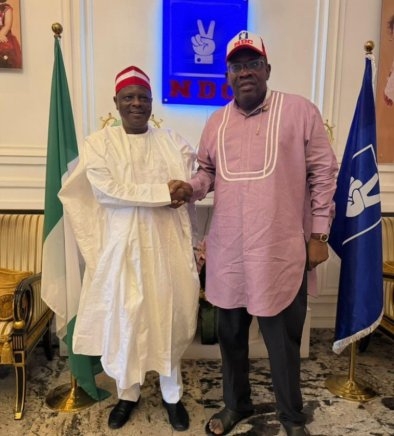
The Nigerian Democratic Congress (NDC) has intensified internal consultations following a recent court ruling that vacated the earlier decision compelling the Independent National Electoral Commission (INEC) to register the party. Vice Presidential candidate Rabiu Kwankwaso met with the party’s National Leader, Seriake Dickson, on Sunday to discuss the implications of the Federal High Court’s decision in Lokoja, Kogi State. The court, presided over by Justice Isah Dashen, overturned its December 10, 2025 judgment that had ordered INEC to register the NDC as a political party. The reversal came after the Peace Movement Party filed an application arguing it had a legal interest in the matter and should have been included in the original suit.
The court, in suit No. FHC/LKJ/CS/49/2025, ruled that the earlier judgment was constitutionally defective because it was delivered without hearing all necessary parties. This development has sparked widespread debate, with opposition parties accusing President Bola Tinubu’s administration of interfering with the judiciary to undermine political competition. Critics argue that the timing and nature of the ruling suggest undue influence, especially as the 2027 general elections approach.
In a post on his official Facebook page, Senator Dickson confirmed the meeting with Kwankwaso, stating that they discussed “issues of mutual interest concerning our party.” He emphasized that party leaders have united in their resolve to reject what they describe as an attempt to impose a one-party democracy. “We reaffirmed our resolve to stand together in the fight for multi-party democracy,” Dickson said. He also briefed Kwankwaso on steps the NDC is taking to address the challenges arising from the anomalous court ruling.
The NDC leadership insists it remains committed to its goal of securing legal recognition and participating in Nigeria’s democratic process. Dickson’s statement underscores the party’s determination to continue its campaign despite legal setbacks. The party’s leadership is now focusing on legal remedies and public advocacy to ensure transparency and fairness in the electoral process. As the political landscape continues to evolve, the NDC’s next moves will be closely watched by stakeholders across Nigeria.
The outcome of this legal battle could influence the broader political environment, especially as opposition parties seek to strengthen their presence ahead of upcoming elections. The NDC’s resilience in the face of legal challenges highlights the ongoing struggle for inclusive democracy in Nigeria.


Leave a Comment