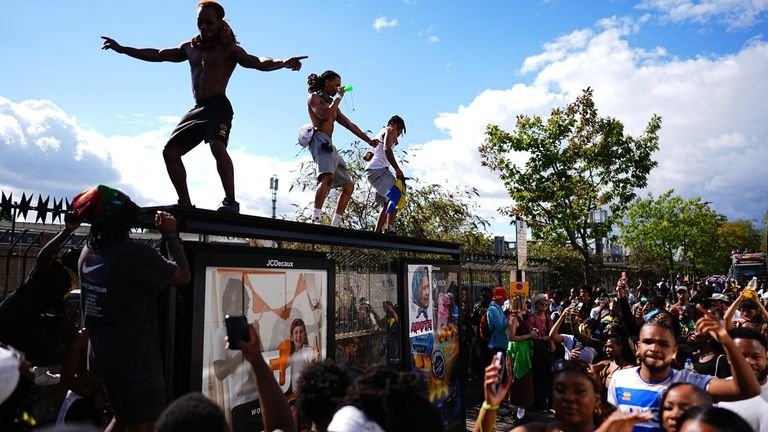
The 60th anniversary of the Notting Hill Carnival was marked with vibrant celebrations across West London, featuring three days of music, dance, and cultural expression that drew thousands to the streets. Europe’s largest street festival, which began in 1966, continues to honor Caribbean heritage and resilience amid a backdrop of historical struggle and community pride. The event, held from Saturday to Monday, showcased live bands, over 30 static sound systems, colorful costumes, and the mouthwatering aroma of jerk chicken, drawing visitors from across the UK and beyond.
The festivities kicked off on Saturday with a steelband competition, followed by the children’s parade and main carnival on Sunday. A solemn moment of reflection was observed during the weekend as attendees stood in a 72-second silence to honor the victims of the Grenfell Tower fire in June 2017, which claimed 72 lives just miles from the carnival grounds. This tribute highlighted the ongoing connection between the local community and broader social issues affecting London.
Security was significantly ramped up for the 2024 edition, with more than 3,000 stewards deployed—double the usual number—and over 7,000 Metropolitan Police officers patrolling the area. Despite these measures, the Met Police reported 243 arrests on Sunday alone, primarily for drug possession, assaults, sexual offences, and weapon-related incidents. Two individuals were hospitalized after sustaining injuries from knife attacks, underscoring the challenges of maintaining public safety during large-scale events.
The roots of the Notting Hill Carnival trace back to a period of racial tension in post-war London. In 1958, Black residents in Notting Hill faced violent attacks from white mobs, sparking widespread concern within the Caribbean diaspora. In response, Trinidadian journalist Claudia Jones organized an indoor Caribbean carnival at St Pancras Town Hall in 1959, creating a safe space for cultural celebration amid discrimination. Her efforts laid the foundation for what would become a global phenomenon.
Tragedy struck again in 1960 when Kelso Cochrane, an Antiguan carpenter, was fatally stabbed in an unprovoked racist attack—a crime that remains unsolved. These events fueled the determination of activists like Rhaune Laslett, who helped transition the carnival from indoor gatherings to outdoor celebrations in 1964. What started as a small community gathering has since grown into one of the world’s most iconic street festivals, attracting millions each year.
As the 60th anniversary concludes, the Notting Hill Carnival stands not only as a celebration of music and culture but also as a powerful reminder of the fight for equality and belonging. Its enduring legacy continues to inspire future generations to honor their heritage while advocating for justice and unity.





Leave a Comment