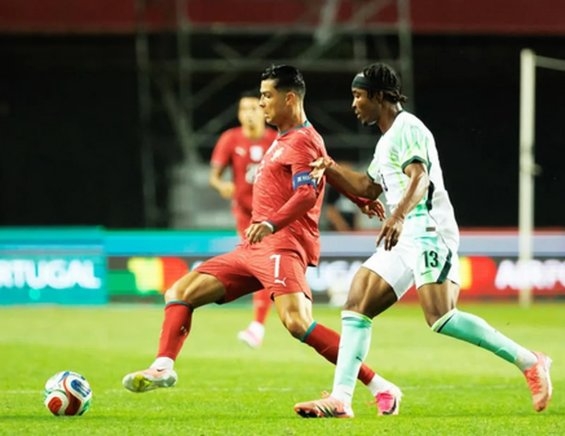
Portugal head coach Roberto Martinez has confirmed that Cristiano Ronaldo was substituted early in the second half during Portugal’s 2-1 friendly victory over Nigeria as part of a pre-planned fitness strategy for the veteran forward. The 39-year-old, who played for the first 60 minutes, was replaced by Gonçalo Ramos at halftime, following a predetermined rotation plan designed to manage player workload. Martinez revealed that Ronaldo’s playing time was scheduled in advance, with other players also assigned specific durations: Diogo Costa was set for 90 minutes, Nuno Mendes for 30, and Vitinha and João Neves for 45 minutes each.
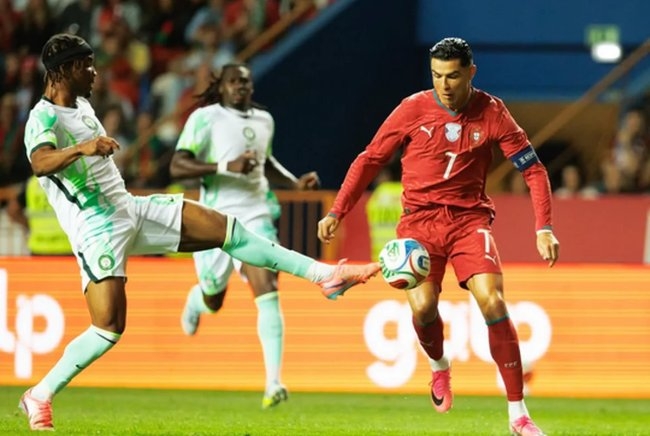
Ronaldo, who previously played for Manchester United, had a frustrating performance against Nigeria, missing several clear scoring chances. Despite his efforts, he was unable to convert opportunities, and his early substitution sparked speculation among fans. However, Martinez clarified that the decision was not due to performance but part of a structured approach to maintain squad depth and freshness for future matches. The coach praised the team’s discipline and focus, emphasizing the importance of executing planned changes smoothly.
Martinez expressed satisfaction with how his team adapted after halftime, noting that Portugal improved significantly in the second half. “It was a difficult game, we created opportunities, we improved in the second half, which is very important to me,” he said. Despite making nine substitutions at halftime, Portugal maintained their intensity and game control. Nigeria, who had a strong first-half showing, failed to register a single shot on target in the second half, highlighting Portugal’s defensive resilience.
The Portuguese coach also commended Nigeria for their physical strength and effective attacking movements. “It was a fantastic test, the opponent was demanding, from a different culture, we don’t usually play against African teams,” Martinez said. He pointed out that Nigeria’s ability to penetrate the box with minimal buildup is a hallmark of strong African sides, similar to teams like Congo. The match served as valuable preparation for both teams ahead of upcoming international fixtures.
This defeat marks Nigeria’s first loss in their last four friendly matches, having previously beaten Jamaica and Zimbabwe in the Unity Cup and drawn with Poland in Warsaw. The Super Eagles, who showed promise in the first half, were unable to sustain their momentum after the break. The result underscores the growing competitiveness of African football on the global stage, as Nigeria continues to build toward major tournaments.
As both teams look ahead, the match offers valuable lessons in tactics, fitness, and adaptability, with Portugal’s structured approach and Nigeria’s physicality setting the tone for future encounters.
Leave a Comment