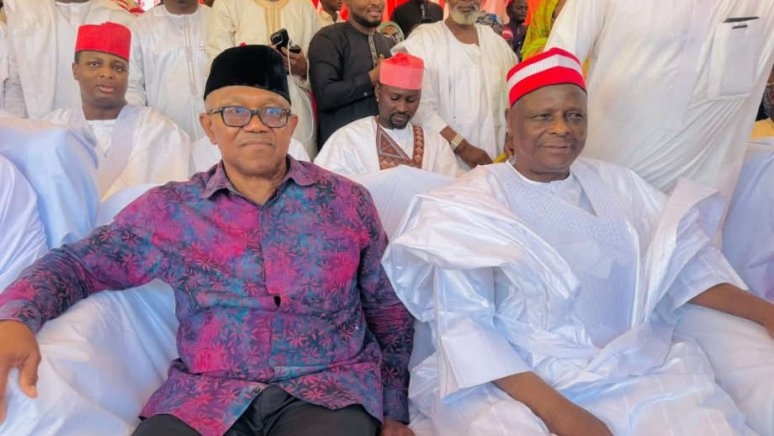
The Nigeria Democratic Congress (NDC) has formally invited former Vice President Peter Obi and former Kano State Governor Rabiu Kwankwaso to join its party and contest the 2027 presidential election. In a social media post on X on Sunday, the party gave the two prominent politicians a two-week window to defect and secure its presidential ticket. The message, accompanied by a photo of Obi and Kwankwaso shaking hands with the caption “Nigeria will be OK,” emphasized urgency and unity. This move comes as supporters of both leaders have already begun mobilizing under the “OK Movement,” a grassroots initiative aimed at building momentum for a potential joint presidential bid.
The NDC’s call for Obi and Kwankwaso to join its ranks reflects growing political realignment ahead of the 2027 general elections. The party’s leadership sees the two figures as key to uniting opposition forces and challenging the dominant political parties. The “OK Movement” has been actively expanding its network, with spokesperson Justin Ijeh recently announcing new appointments to its national and state structures. These appointments signal the movement’s intent to build a formal political infrastructure capable of contesting elections at all levels.
Meanwhile, the African Democratic Congress (ADC), the current party of both Obi and Kwankwaso, is grappling with internal leadership conflicts that may weaken its electoral prospects. A legal battle between factions led by former Senate President David Mark and Nafiu Bala remains unresolved, with the Supreme Court reserving judgment on April 22. This ongoing dispute has created uncertainty within the party and raised questions about its ability to present a united front in the next election.
Adding to the complexity, the Independent National Electoral Commission (INEC) has set May 30, 2026, as the deadline for political parties to submit membership lists and nominate candidates. This timeline has drawn criticism from opposition parties, including the ADC, a faction of the Peoples Democratic Party (PDP), and the New Nigeria Peoples Party (NNPP). They have jointly petitioned INEC to extend the deadline to the end of July, arguing that the current schedule is unfair and could disadvantage parties that are still organizing or restructuring. The request highlights the logistical and administrative challenges facing smaller and emerging parties.
As the political landscape continues to shift, the NDC’s invitation to Obi and Kwankwaso underscores the high stakes of the 2027 election. With party loyalty increasingly fluid and voter sentiment focused on change, the coming months will likely see more strategic alliances and leadership movements. The outcome of these developments could reshape Nigeria’s political future.



Leave a Comment