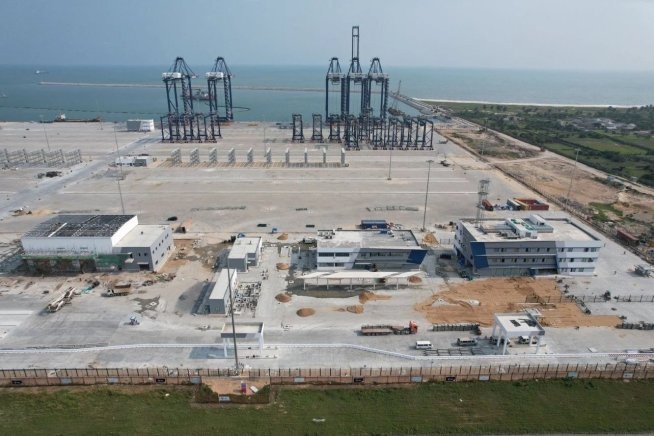
Nigeria’s N1.3 trillion reconstruction programme for Apapa and Tin Can Island ports has remained stalled for eight months despite a financing agreement secured with the United Kingdom in March 2026.
The delay has raised concerns about the Federal Government’s ability to deliver critical maritime infrastructure at a time when Nigerian businesses are struggling with high logistics expenses, expensive financing and growing competition from more efficient ports across West Africa.
The rehabilitation programme, estimated at approximately £746 million, was designed to modernise ageing port infrastructure, improve vessel-handling capacity and reduce the time required to move cargo through Nigeria’s busiest maritime gateways.
However, physical reconstruction has yet to commence, even after the government missed two previously announced construction timelines.
The initial expectation was that work would begin during the second quarter of 2026. By July, the Nigerian Ports Authority (NPA) indicated that preliminary investigations had been completed and contractors were expected to mobilise during the third quarter.
Neither timeline was achieved.
The continued delay is particularly significant because Apapa and Tin Can Island remain central to Nigeria’s international merchandise trade.
Both facilities serve manufacturers, importers, exporters and logistics operators across the country, making their operational efficiency an important determinant of business costs.
Although Nigeria has invested in newer port facilities, including the Lekki Deep Sea Port, substantial volumes of commercial cargo continue to depend on infrastructure developed several decades ago.
Apapa Port was commissioned in 1926, while Tin Can Island Port began operations in 1977.
Their ageing facilities have become increasingly difficult to reconcile with the requirements of modern shipping, which favour deeper channels, stronger quay structures, efficient container-handling equipment and faster vessel turnaround.
Data from the NPA show that operational performance at both ports weakened during the first half of 2026.
At Apapa, average vessel turnaround time increased to 6.1 days from 5.9 days in the corresponding period of 2025.
Tin Can Island recorded a more pronounced deterioration, with turnaround time rising to 5.1 days from 4.4 days.
Vessel turnaround measures the period between a ship’s arrival and departure. Longer turnaround times can increase shipping expenses because vessels remain occupied at ports instead of moving to their next commercial destinations.
These additional costs can eventually affect freight charges and the prices businesses pay to move goods.
The situation is particularly challenging for manufacturers that depend on imported machinery, raw materials, industrial chemicals and production equipment.
Delays in receiving these inputs can disrupt production schedules, increase inventory expenses and force businesses to maintain larger stocks than would otherwise be necessary.
For exporters, unpredictable cargo processing can make it more difficult to meet delivery commitments and compete in international markets.
Nigeria’s port challenges also extend beyond the time vessels spend at berths.
Cargo dwell time, which measures how long shipments remain within port facilities before leaving, continues to reflect significant inefficiencies.
The Nigerian Shippers’ Council reported average cargo dwell time of 13 days in 2024, compared with 14.1 days in 2011.
The limited improvement over more than a decade demonstrates how slowly the country’s cargo-clearance system has evolved despite repeated reforms.
Industry estimates indicate that cargo dwell time at Nigerian ports remained between 10 and 18 days in 2026, compared with approximately seven to 10 days at competing facilities in Lomé and Tema.
These differences matter because importers face additional storage charges, container detention costs and other expenses when cargo remains in the logistics system longer than necessary.
Such costs ultimately affect the competitiveness of Nigerian businesses and can contribute to higher prices for consumers.
The financial consequences can be substantial.
For example, an importer handling 10 containers at an assumed additional charge of N63,000 per container daily could incur N6.3 million in charges if the shipment experiences 10 chargeable days of delay.
While actual costs depend on shipping-line terms, terminal charges and the circumstances of each shipment, the illustration demonstrates how operational delays can quickly erode commercial margins.
For businesses operating with limited working capital, these expenses can be particularly damaging.
The proposed reconstruction is intended to address some of the physical infrastructure constraints behind these problems.
The project includes rehabilitation of quay walls, berths, terminal pavements and associated marine structures.
It also provides for improvements to equipment-support infrastructure, including facilities required to accommodate modern ship-to-shore container cranes.
These upgrades could allow terminals to handle larger vessels more efficiently and improve the movement of cargo between ships, storage areas and inland transportation networks.
However, infrastructure reconstruction alone will not resolve every problem affecting Nigeria’s maritime trade.
Customs procedures, regulatory inspections, cargo documentation, road transportation and terminal operating practices also influence how quickly shipments move through ports.
Consequently, improvements in physical infrastructure must be supported by effective cargo-clearance reforms and stronger coordination among government agencies.
The financing structure of the reconstruction programme has also attracted attention.
The agreement secured during President Bola Tinubu’s visit to the United Kingdom includes significant procurement opportunities for British companies.
At least £236 million in supplier contracts is expected to go to UK businesses, including a £70 million contract involving British Steel for the supply of steel billets.
The arrangement demonstrates the role of export-credit-backed financing in supporting infrastructure projects in developing economies.
However, such agreements also create long-term financial obligations that must be considered alongside the expected economic benefits.
For Nigeria, the commercial justification for the borrowing will depend on whether the upgraded facilities generate measurable improvements in trade efficiency, cargo-handling capacity and port revenue.
The immediate concern is that the financing agreement has not translated into construction activity within the expected period.
A source within the NPA indicated that the Federal Government still needed to meet counterpart funding commitments before the project could fully advance.
Although approval for the first phase of disbursement was reportedly obtained from the Federal Executive Council, the amount required and whether the funds had been released were not disclosed.
The absence of clarity around funding and mobilisation raises questions about the revised project timetable.
The NPA had previously indicated that reconstruction would take approximately 48 months.
Further delays in commencing work could therefore push completion beyond the anticipated late-2030 period.
This would prolong the dependence of Nigerian businesses on ageing infrastructure while competing West African ports continue expanding their facilities and improving operational efficiency.
The competitive implications are considerable.
International shipping companies increasingly assess ports based on vessel turnaround, cargo-handling productivity, infrastructure quality and the predictability of operations.
Ports that offer shorter waiting periods and more efficient cargo processing can attract additional shipping services and regional transit cargo.
Nigeria risks losing some of these opportunities when shipping operators can obtain faster and more predictable services elsewhere.
The implications extend beyond maritime businesses.
Higher port expenses affect the cost structure of manufacturers, retailers, agricultural exporters and other companies that depend on international trade.
For manufacturers already facing expensive energy, high interest rates and exchange-rate uncertainty, additional logistics costs further weaken their ability to compete with foreign producers.
Similarly, agricultural exporters seeking access to international markets require reliable shipping arrangements to protect product quality and meet delivery schedules.
The Federal Government has repeatedly identified port modernisation as an important component of its economic diversification and trade facilitation strategy.
Yet, the continued delay highlights the difference between securing project financing and delivering functioning infrastructure.
The priority now is to establish a credible construction timetable, clarify outstanding funding obligations and ensure that implementation is subject to transparent monitoring.
The N1.3 trillion reconstruction programme has the potential to improve Nigeria’s maritime competitiveness, but the economic benefits will remain unrealised until physical work begins and operational improvements become measurable.
For Nigerian businesses, every additional delay means continued exposure to logistics inefficiencies that undermine productivity, increase trade expenses and weaken competitiveness in regional and international markets.





Leave a Comment