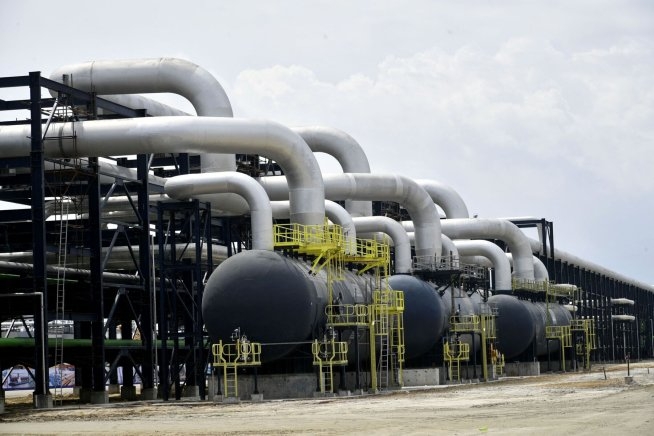
Dangote Industries’ ambitious $40 billion energy investment plan over the next five years is facing a critical test as the company seeks to secure sufficient crude oil and capital to expand its Lagos refinery and build a massive new refinery in Lamu, Kenya. The project includes a $14.3 billion expansion of the existing 700,000-barrel-per-day (bpd) Lagos refinery to 1.4 million bpd by 2029, and a proposed $15–$16 billion Lamu refinery with 700,000 bpd capacity, expected to be completed around 2030. Together, these facilities would require about 2.1 million barrels of crude daily—equivalent to over 766 million barrels annually—posing significant challenges for supply and financing.
Crude availability has already been an issue for the Lagos refinery, which sources 30% to 40% of its feedstock from international markets such as the United States, despite being located in Nigeria, Africa’s largest oil producer. Nigerian crude is often committed under existing contracts or export deals, limiting domestic access. Additionally, some local crude can be more expensive than imported alternatives due to pricing benchmarks and commercial terms. The expanded Lagos refinery alone will need approximately 511 million barrels of crude annually, demanding a much broader and diversified supply network.
In Kenya, the challenge is even greater. The country currently lacks commercial crude production capable of supporting a 700,000-bpd refinery. While officials suggest up to 600,000 bpd could eventually come from East African sources including Uganda and South Sudan, infrastructure and regional coordination remain underdeveloped. Uganda’s oil exports are tied to the East African Crude Oil Pipeline heading to Tanzania, while South Sudan relies on transit routes through Sudan. Kenya’s own Lokichar Basin discoveries have not yet led to sustained production, and pipeline links to Lamu are still incomplete. This leaves seaborne imports as a likely early source, exposing the refinery to volatile freight costs and geopolitical risks, especially given recent disruptions in Middle Eastern supply routes.
Financing the entire $40 billion programme will also be complex. Dangote plans to use internally generated cash, bonds, and potentially a public offering for the Kenya refinery, with regional governments possibly holding up to 30% equity. The Lagos refinery’s IPO, offering 4.1 billion shares at N525 each (raising about N2.15 trillion or $1.6 billion), will support part of the expansion but is only a fraction of the total funding needed. The group’s financial strength has improved significantly, with the Lagos refinery reporting $1.82 billion in after-tax profit for the first half of 2026, compared to a $476 million loss in all of 2025. Strong global refining margins, driven by disruptions in Russian and Middle Eastern supplies, have boosted earnings and enhanced investor appeal.
However, the success of this expansion hinges on managing multiple large-scale projects simultaneously without overextending finances or supply chains. The original Lagos refinery took years longer than planned and cost nearly $20 billion, highlighting the execution risks. Environmental concerns also loom, particularly around Lamu Old Town, a UNESCO World Heritage site. Despite these hurdles, Kenyan President William Ruto strongly supports the project, citing potential savings of billions from reduced fuel imports and broader economic benefits.
Ultimately, Dangote’s ability to scale its refining operations across Africa will depend on securing stable crude supplies and sustainable financing. If successful, the Lamu refinery could position Dangote as a central player in Africa’s energy landscape, supplying petroleum products and petrochemicals across the continent. But the road ahead requires careful navigation of market cycles, geopolitical shifts, and industrial complexity—making this one of the most significant tests of private enterprise in African energy history.



Leave a Comment