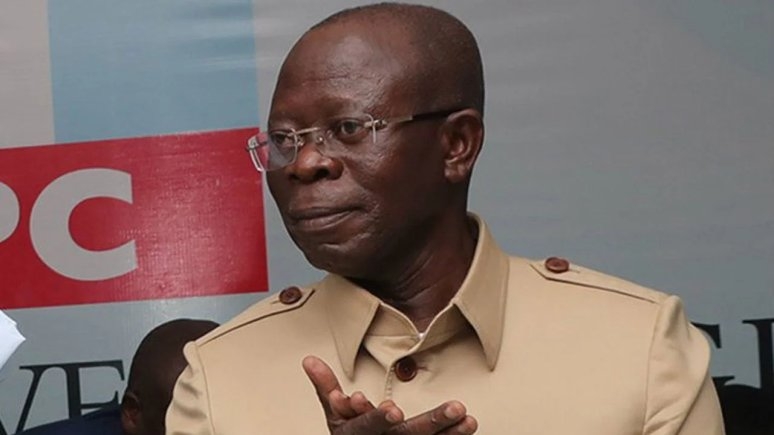
The claim by former Minister of Transportation Rotimi Amaechi that he was the key figure who made Muhammadu Buhari president in 2015 has been strongly challenged by Senator Adams Oshiomhole, representing Edo North Senatorial District. In a recent interview on The Mic On Podcast, Oshiomhole stated that Amaechi did not even vote for Buhari during the 2015 presidential election. He accused the former Rivers State Governor of misleading the public by taking credit for Buhari’s victory, despite having actively discouraged voter participation in his home state.
Oshiomhole explained that Amaechi, who served as Director-General of Buhari’s campaign, was overwhelmed by political opposition from then Rivers State Governor Nyesom Wike. This internal conflict, according to the senator, led Amaechi to instruct his supporters in Rivers State to boycott the election. “Amaechi lied that he made Buhari president,” Oshiomhole said. “He was not able to vote for Buhari in 2015 because he unwisely directed the people of Rivers State to boycott the polls.”
The senator emphasized that as campaign director, Amaechi had the authority to influence voter turnout in key areas. His directive to abstain from voting in Rivers State, Oshiomhole argued, directly undermined Buhari’s campaign efforts in a critical electoral zone. This decision, he added, contradicts Amaechi’s public assertion that he was instrumental in Buhari’s victory.
Amaechi had previously made the claim during an interview on Arise TV, where he positioned himself as the primary architect of Buhari’s 2015 win. He suggested that his leadership and organizational skills in mobilizing support were the main reasons Buhari defeated incumbent President Goodluck Jonathan. However, Oshiomhole’s revelation casts doubt on that narrative, pointing to Amaechi’s own actions as evidence of his failure to deliver votes in a crucial state.
The exchange highlights ongoing tensions within Nigeria’s political landscape, particularly among former allies who once worked together under the All Progressives Congress (APC). It also underscores the importance of accurate historical narratives in shaping public perception of political achievements. As Nigeria prepares for future elections, such clarifications may influence voter trust and political accountability.
This controversy adds context to the broader debate on who truly contributed to Buhari’s rise to power, and whether credit is being fairly assigned. The issue may continue to surface as political figures reflect on past campaigns and position themselves for future leadership roles.

Leave a Comment