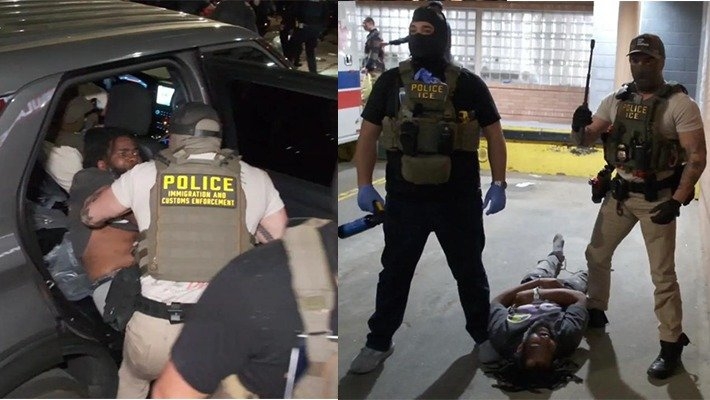
Protests broke out in New York City on Saturday night following the arrest of Chidozie Wilson Okeke, a Nigerian man with a prior criminal record, by U.S. Immigration and Customs Enforcement (ICE) agents during a targeted operation in Brooklyn. The incident, part of President Donald Trump’s broader crackdown on illegal immigration, sparked unrest as demonstrators gathered outside Wyckoff Heights Medical Centre, where Okeke was taken for a medical evaluation. The Department of Homeland Security (DHS) confirmed that Okeke had previous arrests for assault and criminal drug possession, making him a target in the enforcement operation.
According to DHS, Okeke resisted arrest and became physically combative during the operation. Officers reported that he refused to comply with lawful commands to exit his vehicle and attempted to use the vehicle as a weapon to strike ICE agents. The agency stated that Okeke also tried to punch and elbow officers, forcing them to use the minimum amount of force necessary to subdue him. The DHS emphasized that officers acted in accordance with their training and protocols during the arrest.
Okeke was transported to Wyckoff Heights Medical Centre at his own request, where he underwent a medical evaluation. However, he remained uncooperative throughout the process. As news of his arrest spread, dozens of anti-ICE protesters converged on the hospital. The demonstrators threw objects onto the road, blocking access and attempting to prevent ICE vehicles from leaving the area. The situation escalated quickly, with several ICE agents reportedly assaulted and their vehicles damaged.
The New York Police Department (NYPD) was called to the scene to restore order, leading to the arrest of at least a dozen individuals suspected of rioting and assaulting law enforcement. DHS officials condemned the violence, stating that assaulting law enforcement officers is a felony and a serious crime. They reiterated that the enforcement operation was conducted legally and with due regard for safety.
The incident has drawn attention to the tensions surrounding immigration enforcement and the growing activism against ICE operations in urban centers. While the DHS maintains that the arrest was justified based on Okeke’s criminal history, the violent response from protesters highlights the deep divisions in public opinion on immigration policy and law enforcement tactics. The case is expected to continue generating debate as authorities review the circumstances and consider next steps in the legal process.


Leave a Comment