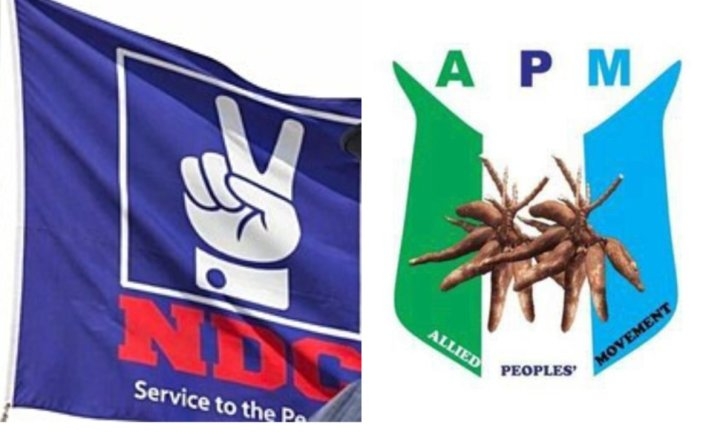
The Nigerian Democratic Congress (NDC) and Allied Peoples Movement (APM) are facing a potential legal and political crisis over allegations that their National Legal Adviser, Barr. Reuben Egwuaba, holds dual membership in both opposition parties—a move that violates Nigeria’s revised Electoral Act. According to records verified on the Independent National Electoral Commission (INEC) website, Egwuaba is officially listed as the National Legal Adviser for both parties, raising serious concerns about compliance with electoral laws. This development has drawn criticism from electoral reform advocates, who stress that such dual affiliation is not only unethical but also a criminal offense under current legislation.
Checks conducted by DAILY POST on the INEC portal, www.inecnigeria.org, confirm that Egwuaba’s name appears in the official party leadership lists for both the APM and NDC. The position of National Legal Adviser is a key role within a party’s National Executive Committee (NEC), requiring full and exclusive membership. Therefore, holding this position in two parties simultaneously is seen as a direct contradiction of Section 77 of the amended Electoral Act, which explicitly prohibits dual party membership.
Activist Julius Aondowase, in a statement issued on Sunday, described the situation as more than a clerical error. He emphasized that the law is clear and unambiguous: anyone found guilty of dual party membership faces a fine of up to ₦10 million or a prison term of up to two years. “This is not a minor issue,” Aondowase said. “It constitutes prima facie evidence of a criminal offense and undermines the integrity of Nigeria’s democratic process.” He further called on electoral authorities to investigate the matter without delay and take appropriate legal action.
Aondowase stressed that the public deserves transparency and accountability. If the records are accurate, it represents a flagrant violation of the law. If not, he urged immediate correction and explanation for how such conflicting information was officially documented. “Nigeria’s democracy must be governed by rules, not convenience,” he added, highlighting the need for institutions to uphold legal standards.
This controversy emerges at a time when the NDC is gaining momentum following the defection of prominent figures like Peter Obi, former governor of Anambra State, and Rabiu Kwankwaso, former governor of Kano State. The party’s growing influence makes the scrutiny of its leadership structure even more critical. As Nigeria prepares for future elections, the integrity of political parties and their leadership will be under increasing public and legal scrutiny. The outcome of this case could set a precedent for how electoral laws are enforced in the country.




Leave a Comment