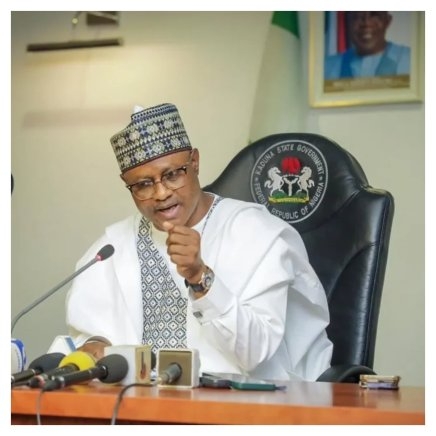
Governor Uba Sani of Kaduna State has hailed the late Chief Gani Fawehinmi as a towering figure in Nigeria’s democratic journey, emphasizing that his most significant contribution was his unwavering commitment to keeping the political space open for all Nigerians. Speaking at the public presentation of the book ‘Gani Fawehinmi And Uba Sani, A Tale Of Mentor And Mentee’ in Kaduna on Saturday, the Governor recalled how Fawehinmi led a crucial legal battle against the Independent National Electoral Commission’s (INEC) restrictive conditions for registering political parties. At a time when many pro-democracy activists were losing faith, Fawehinmi urged them to maintain hope and use the judiciary to defend democracy.
The legal challenge, spearheaded by Fawehinmi alongside Alhaji Balarabe Musa, lasted over two years before the Court of Appeal delivered its judgment in 2002. INEC appealed to the Supreme Court, but in January 2003, the apex court again ruled in favor of the plaintiffs. Governor Sani described this landmark decision as pivotal in opening Nigeria’s political space, enabling the emergence of numerous political parties and reinforcing citizens’ rights to organize politically. He stressed that every new party and every citizen exercising their political freedoms today owes a debt to those who fought for such liberties through difficult struggles.
Sani also highlighted Fawehinmi’s deep belief in education as a tool for national development. He revealed that he played a key role in establishing the Gani Fawehinmi Scholarship Foundation, serving as Northern Coordinator. The initiative, launched 26 years ago at Arewa House, aimed to support brilliant but indigent university students across Northern Nigeria, where educational deprivation was particularly acute. Over 1,000 students have benefited from the scholarship, many of whom have become doctors, lawyers, engineers, and academics contributing significantly to national progress.
Recalling Fawehinmi’s warning that unchecked educational backwardness could become a “monster,” the Governor noted that this remains deeply relevant today. He linked many of the region’s current challenges to inadequate investment in human capital. Describing Fawehinmi as one of Nigeria’s most formidable figures, Sani praised his courage to prioritize justice over comfort and his use of law as an instrument of liberation. He commended Mrs. Basirat Fawehinmi-Biobaku, the author of the book, for capturing not just a personal mentorship but a story of national significance—about leadership, social justice, and intergenerational responsibility.
Governor Sani called on activists, politicians, and academics to regularly honor those who sacrificed for Nigeria’s democracy. He emphasized that Fawehinmi’s legacy continues to inspire efforts toward a more inclusive, just, and educated nation. As Nigeria faces ongoing challenges, the lessons from Fawehinmi’s life remain essential for building a stronger, more resilient democracy.

Leave a Comment