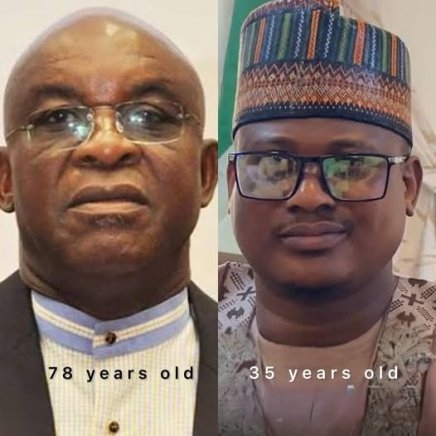
Ambassador Reno Omokri has sharply criticized former Senate President David Mark over his reported participation in a leadership battle within the African Democratic Congress (ADC), calling the development troubling and reflective of deeper systemic failures in the party. Omokri, a prominent Nigerian political commentator and former aide to President Goodluck Jonathan, took to social media to express his dismay over the power struggle between Mark, who will turn 78 on April 8, 2026, and 35-year-old Nafiu Bala, a younger party member. He questioned the appropriateness of such a contest, highlighting the stark generational divide and the implications for leadership continuity in Nigerian politics.
Omokri emphasized Mark’s long-standing political career, noting that he received his first official appointment in 1976 — a span of 50 years in public service. He contrasted this with Bala’s relative inexperience and youth, stating that it is “sad” to see a seasoned politician like Mark engaged in a power tussle with someone nearly the same age as his first grandchild. “Why would God bless anyone to get to the ripe old age of 78, and you will at that stage of your life be dragging a position with someone who is fifteen years younger than your daughter?” Omokri wrote, underscoring the emotional and ethical dimensions of the conflict.
The former aide argued that the situation goes beyond individual personalities and points to a broader dysfunction within the ADC. He blamed the party’s internal structures, noting that elders who should be mediating disputes are themselves involved in the struggle for influence. “The problem with the ADC is that the elders in that party, who should have been in charge of conflict resolution organs… are the very people struggling for power,” Omokri stated. This, he said, has eroded the party’s moral foundation and undermined its cohesion.
Omokri further clarified that the internal crisis cannot be attributed to external forces such as the Federal Government, the Presidency, or the Independent National Electoral Commission. Instead, he placed full responsibility on the party leadership for failing to uphold democratic norms and institutional integrity. He warned that such infighting weakens the party’s ability to serve the public and damages its credibility among voters.
The controversy has drawn attention to the challenges of leadership transition in Nigerian political parties, where age, experience, and generational dynamics often collide. As the ADC grapples with internal divisions, the outcome of this leadership struggle could influence the party’s future direction and its role in upcoming elections. The incident also serves as a reminder of the need for stronger party governance and succession planning in Nigeria’s political landscape.





Leave a Comment